
Blue Opal Meaning: Symbolism, Properties, and Uses
Written by Roc Gong | Founder of RoCrystal
Last updated: October 28, 2026
Blue opal meaning commonly centers on calm, thoughtful communication, and self-expression. In modern crystal traditions, people choose it as a symbol of speaking honestly, listening with patience, and making space for reflection. These associations express spiritual beliefs and personal intentions rather than guaranteed effects.
The name “blue opal” also covers different appearances. A stone with a soft blue body color can look quite different from an opal that flashes blue as it moves. Understanding that distinction helps you appreciate both the symbolism and the actual material.
What Does Blue Opal Mean?
Blue opal often represents a peaceful approach to expressing thoughts and feelings. Some people connect its blue tones with open skies or quiet water. Others choose it as a personal reminder to pause before speaking or approach a conversation with care.
Its meaning is flexible rather than a fixed rule. A gift, piece of jewelry, or small display stone can carry a message that reflects the person choosing it.
Calm and Reflection
The calm symbolism of blue opal offers a simple theme for personal reflection. Someone might keep a piece beside a journal or wear a pendant as a reminder to take a quiet moment during a busy day.
That meaning does not require a complicated ritual. For example, the stone can mark an intention to make time for rest, consider a decision carefully, or notice what matters most. Its role is symbolic; the person’s habits and choices give that intention practical value.
Communication and Self-Expression
Blue opal also symbolizes honest expression and patient listening. In this context, communication includes both sharing your own thoughts and allowing someone else room to speak.
A blue opal gift might therefore express encouragement before a presentation, a creative project, or a new chapter in someone’s life. A short message such as “a reminder to speak with clarity and listen with kindness” explains the sentiment without promising confidence or success.
For a broader introduction to the symbolism of other varieties, explore our Opal Meaning guide.
What Is Blue Opal?
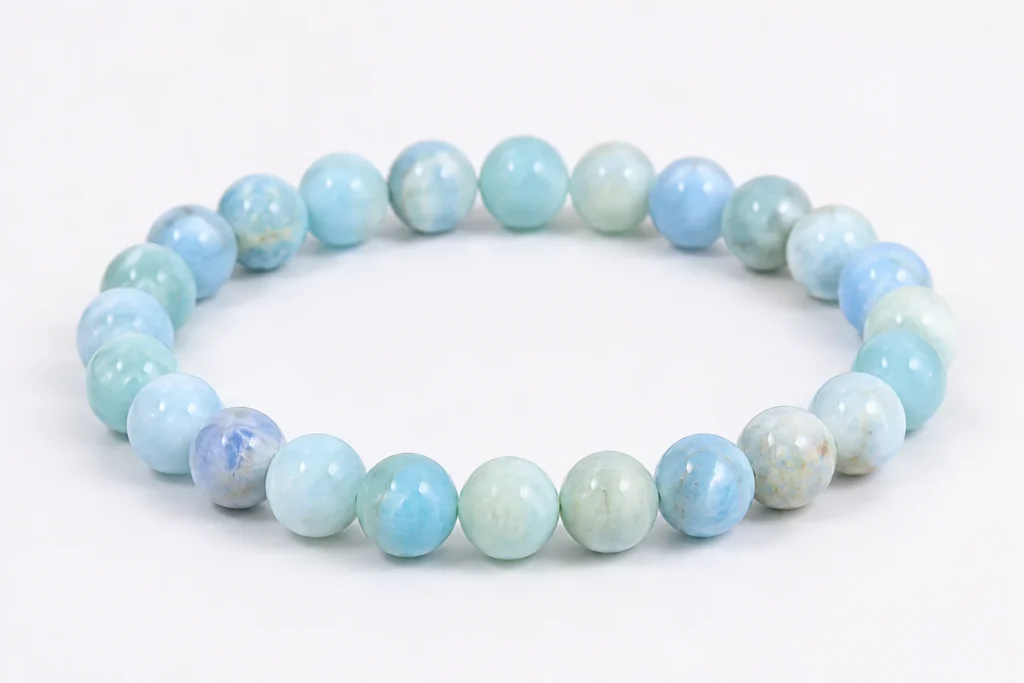
Blue opal is a descriptive name for opal with a blue or blue-green appearance. It does not identify one specific origin, quality grade, or treatment status.
Opal consists of hydrated silica. Unlike quartz, it does not have a regular crystal structure, although retailers often include it in “crystal” collections. GIA’s opal reference lists its composition as SiO₂·nH₂O and its Mohs hardness as 5–6.5.
| Property | General Description |
|---|---|
| Composition | Hydrated silica |
| Structure | Amorphous rather than crystalline |
| Blue appearance | May describe body color or visible play-of-color |
| Mohs hardness | 5–6.5 |
| Product information to confirm | Material identity, origin claims, treatments, and construction |
These properties describe opal generally. An individual product still needs its own accurate material description.
Blue Body Color vs. Blue Play-of-Color
Body color is the stone’s overall background color. A piece of common blue opal may look pale blue, milky blue, or blue-green without showing rainbow flashes.
Play-of-color, by contrast, describes flashes of spectral color that appear as the stone or light moves. GIA distinguishes precious opal, which displays this effect, from common opal, which does not.
This means a blue stone without flashes can still be genuine opal. Equally, an opal showing bright blue flashes does not necessarily have a blue body color. Keeping these features separate makes product photos, descriptions, and price comparisons easier to understand.
Peruvian, Andean, and Australian Names
Peruvian blue opal refers to material associated with Peru. Sellers also use “Andean opal” for Peruvian material, but the broader name alone does not verify a particular mine or source.
“Australian” likewise describes a claimed geographic origin rather than one fixed blue appearance. Ask whether a listing describes blue body color, predominantly blue play-of-color, or both.
For any origin label, request supporting information from the seller. Color alone cannot establish where a stone formed, and a geographic name does not automatically prove that it is untreated.

Blue Opal Spiritual Meaning and Chakra Associations
In modern crystal practices, blue opal spiritual meaning often relates to honest expression, inner reflection, and patient listening. Some people use it as a personal symbol during meditation or journaling. Others simply appreciate the connection between its blue appearance and their own idea of calm.
These interpretations belong to spiritual belief systems. They do not describe measurable properties of the material.
The Throat Chakra and Thoughtful Communication
Practitioners commonly associate blue opal with the throat chakra, an energy center connected with speech and self-expression in chakra-based traditions. Within this framework, the stone can symbolize finding words for your thoughts while respecting another person’s perspective.
For example, someone might hold a piece before journaling about a difficult conversation. The intention could be to separate what they want to say from how they want to say it. The stone serves as a reminder; reflection and communication skills remain the practical tools.
For a gift card or jewelry description, “associated with thoughtful communication” conveys this symbolism without claiming that wearing the stone will change someone’s behavior.
Reflection, Intuition, and Personal Meaning
Some crystal traditions also connect blue opal with the third eye chakra and intuition. Here, intuition can form part of a personal practice of noticing thoughts, asking questions, and considering decisions. It should not imply that the stone provides reliable predictions or special knowledge.
Astrological associations vary between traditions as well. No single zodiac connection determines who can enjoy blue opal jewelry. Personal preference, comfort, and the meaning someone gives the piece offer more useful starting points than rigid wearing rules.
How to Use and Wear Blue Opal
Blue opal can serve as a decorative material, a meaningful gift, or an object for personal reflection. Choose the product form according to how you plan to use it, then consider its construction and care requirements.
Beads and Bracelets
Loose beads give jewelry makers control over color placement, spacing, and the overall design. Before stringing, compare the pieces under consistent lighting and check bead dimensions, hole sizes, and drill-hole edges.
Our stone beads collection provides options for exploring gemstone jewelry designs. Confirm the specific material and any treatment information when selecting items for a blue opal project.
Finished bracelets offer a convenient way to wear a personal symbol of thoughtful communication. Check the fit, bead surfaces, and stringing before choosing one. You can also browse our stone bracelets collection to compare different gemstone styles.
Rings and Pendants
A blue opal ring places the stone where you can easily see it, making it suitable for a personal reminder or a meaningful gift. However, hands frequently encounter hard surfaces, so consider how well the setting protects the stone. Remove delicate rings before manual work or activities that could cause knocks.
A pendant offers another way to feature the material, with fewer routine impacts than a ring. Choose a secure setting and a chain suited to the pendant’s weight. For either form, ask whether the stone is solid opal, a layered product, or another disclosed material, since construction affects care.
Tumbled Stones and Personal Displays
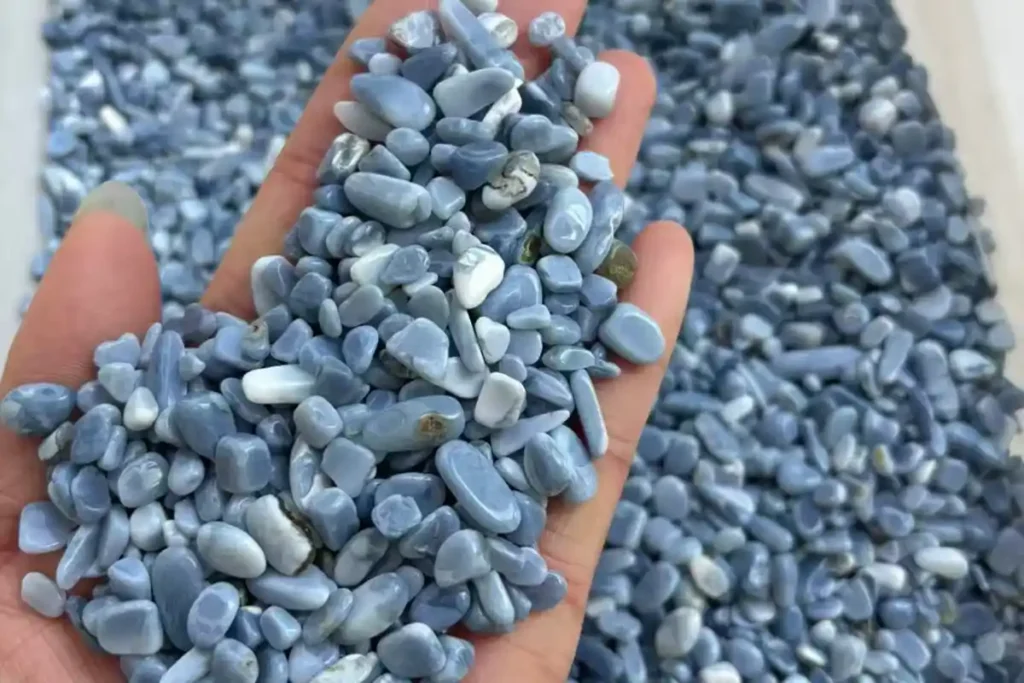
A polished piece can sit beside a journal, on a desk, or in a small display. Some people hold one during meditation as a reminder to pause and reflect. Others enjoy its color without attaching a spiritual meaning.
If you prefer loose polished pieces, explore our tumbled stones collection and confirm current material availability before ordering.
For gifts, include the material name, relevant care information, and a short message. “A reminder to speak thoughtfully and listen with kindness” explains the symbolism without promising a particular result.
How to Choose Blue Opal: Identity, Quality, and Value
Start with the material description, then compare appearance, condition, and workmanship. “Blue opal” alone does not tell you whether a product is natural, treated, laboratory-grown, or assembled from layers.
Material and Treatment Information
Ask the seller to identify what the product contains and disclose any known treatments. Keep these categories separate when comparing offers:
| Description | What to Clarify |
|---|---|
| Natural opal | Whether it has received any treatment beyond cutting and polishing |
| Treated opal | What treatment the seller discloses and whether it requires special care |
| Synthetic opal | Whether the material is laboratory-grown opal |
| Imitation opal | What material creates the opal-like appearance |
| Assembled opal | Whether the piece combines an opal layer with a backing, cap, or other component |
These descriptions do not all mean “fake.” Accurate disclosure lets you decide whether a product suits your design, budget, and labeling needs.
Avoid relying on a single visual clue to establish identity. An even color does not automatically prove treatment, while natural-looking variation does not prove natural origin. If an important purchase depends on identification, request an appropriate report from a qualified gemological laboratory.
Color, Condition, and Workmanship
Compare stones under similar lighting and ask for more than one viewing angle. For material with play-of-color, a short video can show changes that a still photograph misses. For common blue opal, focus on the body color, its distribution, and the overall appearance.
Next, inspect the surface for chips, pits, visible cracks, and poorly finished areas. Check details that matter to the finished product too: drill-hole edges on beads, secure settings on pendants, and protective construction on rings.
Natural patterns may suit one design but distract from another. Decide whether you want a varied assortment or a closely matched color range before confirming an order.
Compare Like-for-Like Value
A strand of common blue opal beads and a precious opal cabochon with blue flashes are different products. Their prices should not serve as direct benchmarks for one another.
When comparing quotations, match the material category, dimensions, condition, treatment disclosure, and workmanship. For finished jewelry, include the setting, metal, assembly, and packaging in that comparison.
Clear specifications make the price more useful than a broad claim such as “premium blue opal.” They also help prevent misunderstandings about what you will receive.
How to Care for Blue Opal
Care for blue opal according to its material, treatments, and construction. A solid stone, a layered opal product, and a bead bracelet may need different handling. If the product description leaves those details unclear, ask the seller before cleaning.
Clean Gently
Start with a soft cloth to remove dust and fingerprints. Before using water or a cleaning solution, check the instructions for the specific piece. Avoid prolonged soaking when you do not know its treatment status or whether adhesives hold its layers together.
For jewelry, consider the other components too. Elastic cord, metal settings, glued fittings, and decorative finishes may require different care from the stone itself. After cleaning, let the piece dry fully before storing it.
Reduce Scratches and Accidental Damage
Keep individual pieces in soft pouches or separate compartments so they do not rub against other jewelry. Remove rings and bracelets before manual work, sports, or activities that could knock them against hard surfaces.
Also, keep opal jewelry away from high heat and sudden temperature changes. A windowsill, hot car, or nearby heater is a poor place to store a delicate piece.
Separate Cleaning from Spiritual Rituals
Some people include sound, intention-setting, or quiet reflection in a crystal ritual. These practices express personal beliefs; they do not remove dirt or confirm a physical change in the stone.
You do not need saltwater, smoke, or direct sunlight to appreciate blue opal’s symbolism. A simple ritual that respects the product’s care instructions can carry the same personal meaning.
Frequently Asked Questions
Are Blue Opals Expensive?
Prices vary widely because “blue opal” covers different products. Common blue opal beads and precious opals with blue play-of-color do not share one price range. Compare material identity, dimensions, condition, treatment, and workmanship before deciding whether an offer represents good value.
What Birth Month Is Blue Opal?
Opal is an October birthstone, as listed by GIA’s October birthstone guide. Blue opal can therefore be a color choice for an October gift; it does not have a separate birth month.
Is Blue Opal a Real Stone?
Yes, natural blue opal exists. However, a product name alone does not establish that a particular item is natural opal. Check whether the seller identifies it as natural, treated, synthetic, imitation, or assembled material.
Who Should Not Wear Opal?
There is no universal zodiac rule that prevents someone from wearing opal. Practical suitability depends on the jewelry and the wearer’s activities. Choose a comfortable fit, avoid components that irritate your skin, and remove delicate pieces before work that could damage them.
How Can You Tell Whether Blue Opal Is Natural, Treated, or Imitation?
Start with clear seller disclosure and supporting documentation. Appearance alone may not settle the question, especially from a photograph. For a significant purchase, ask a qualified gemological laboratory what testing is appropriate. Avoid scratch, heat, or chemical tests at home, which can damage the piece without providing a reliable identification.
Conclusion
Blue opal meaning often centers on calm reflection, thoughtful communication, and self-expression. You can enjoy those associations as personal symbolism or simply appreciate the stone’s blue appearance.
When choosing a piece, distinguish blue body color from blue play-of-color. Then check the material description, condition, workmanship, and care requirements. Clear information helps you select a product that suits your intended use.
For sourcing inquiries, send your preferred product type, dimensions, quantity, and material requirements through our contact form or WhatsApp. We can discuss available options and the details to confirm before ordering.
Disclaimer: Spiritual meanings, chakra connections, and zodiac associations reflect beliefs and personal interpretations. They do not establish medical benefits or guarantee emotional or life outcomes. Gemstones do not replace professional healthcare.
References
- GIA — Opal: composition, hardness, and general gemstone information.
- GIA — Opal Description: the distinction between common and precious opal and the explanation of play-of-color.
- GIA — October Birthstones: opal’s October birthstone association.
These references support gemological and birthstone information, rather than spiritual claims.