
Why Does Pyrite Form in Cubes? How Natural Pyrite Crystals Grow
Written by Roc Gong | Founder of RoCrystal
Published: November 15, 2026
A pyrite cube gets its shape as the crystal grows. Pyrite’s internal structure has cubic symmetry, which makes a cube one of its possible shapes. The final shape depends on how fast different crystal faces grow. When six square faces remain visible, the crystal takes the form of a cube. Pyrite can also grow as an octahedron or a pyritohedron. Handbook of Mineralogy — Pyrite
Cubic pyrite crystals can have flat faces and straight edges that look cut. To understand how those faces form, it helps to start with where pyrite grows. From there, we’ll look at why some crystals develop as cubes and what you can observe on a natural specimen.
How Does Pyrite Form?
Pyrite, also known as iron pyrite, forms when iron and sulfur combine under suitable conditions. The pyrite formula, FeS₂, shows that the mineral contains two sulfur atoms for every iron atom. Pyrite can form in sediments or in cracks where hot, mineral-bearing fluids circulate. Handbook of Mineralogy — Pyrite
How Is Pyrite Formed in Nature?
In waterlogged sediments with little oxygen, microbes can help produce sulfide. That sulfide can react with iron, contributing to the formation of pyrite. In hydrothermal settings, pyrite can crystallize from hot fluids moving through fractures in rock. These examples explain where the mineral can form. The next section looks at what gives an individual crystal its shape.
How Do Pyrite Cubes Form?
A pyrite cube takes shape as new material attaches to a growing crystal. To see why the result can have six square faces, it helps to look at two things. First, the atoms inside the crystal follow a repeating pattern. Second, the crystal’s outer faces can grow at different rates.
The Crystal Structure of Pyrite
Inside each crystal, iron and sulfur atoms form a repeating pattern. This pattern gives the crystal structure of pyrite its cubic symmetry. Although the crystal system of pyrite stays the same, the visible faces can vary depending on how the crystal grows. For example, a cube and an octahedron both belong to the same pyrite crystal system. Handbook of Mineralogy — Pyrite
Why Does Pyrite Form Cubes?
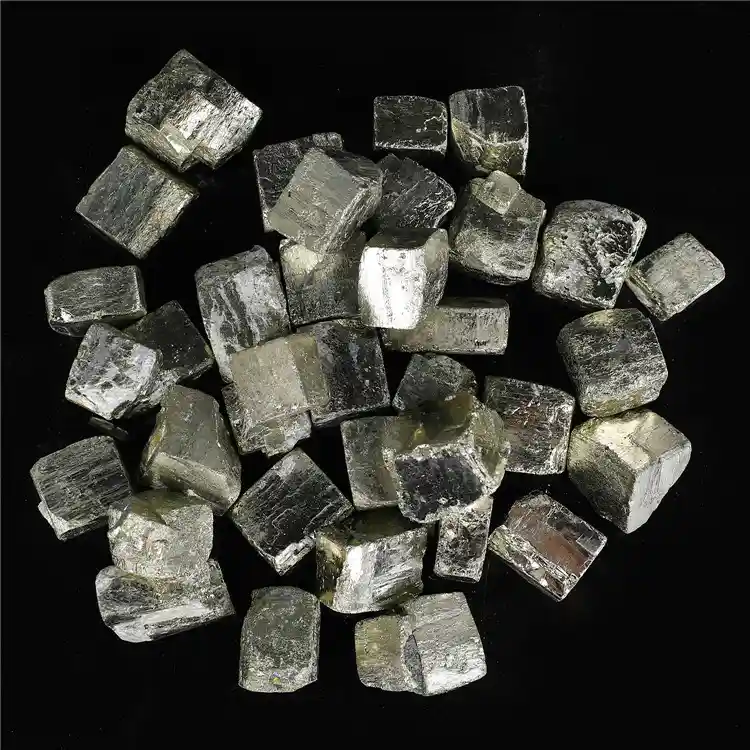
As a crystal grows, some faces advance outward faster than others. The slower-growing faces tend to stay visible, while faster-growing faces can shrink or disappear from the outline. In cubic pyrite, six equivalent faces dominate the finished shape. These faces meet at right angles, giving the crystal its flat sides and straight edges. If the growth conditions favor a different set of faces, the same mineral can develop a different shape.
Crystal Form and Shape of Pyrite
The crystal form of pyrite describes the arrangement of its outer faces. For example, a cube has six square faces, while an octahedron has eight triangular faces. A pyritohedron, meanwhile, has twelve pentagonal faces. Use the table below to compare the crystal shape of pyrite across these three forms. Handbook of Mineralogy — Pyrite
| Pyrite crystal form | Face shape | What to look for |
|---|---|---|
| Cube | Six square faces | Flat sides that meet at right angles |
| Octahedron | Eight triangular faces | A shape like two square pyramids joined at the base |
| Pyritohedron | Twelve irregular pentagonal faces | Five-sided faces with edges of different lengths |
What Is the Crystal Habit of Pyrite?
The crystal habit of pyrite describes the overall appearance of a single crystal or a group of crystals. For example, one specimen may show a single, well-defined cube, while another forms a cluster. In addition, an individual crystal can display faces from more than one form. As a result, the overall shape of pyrite can be harder to recognize if you look at just one face. To identify the pyrite crystal habit, turn the specimen under good light and look at how its faces meet.
Are Pyrite Cubes Natural?
Yes. Natural pyrite cubes, sometimes called “cubed pyrite” in listings, can have flat faces and straight edges that look as precise as a cut stone. For example, the faces of a nearly perfect pyrite cube may show fine parallel lines, known as striations. Other specimens may have smooth faces. As a result, a smooth face alone tells you little about whether the surface was polished. Handbook of Mineralogy — Pyrite
Why Are Some Pyrite Cubes Attached to Rock?
Collectors call the host material that remains attached to a crystal its matrix. For example, a specimen may have several pyrite cubes projecting from the same piece of rock. A loose natural pyrite cube, meanwhile, can show more of its faces. When comparing listings, check whether the stated dimensions refer to the whole specimen or to a single crystal.
Pyrite Cubes from Spain
Navajún, Spain, is a well-known locality for cubic pyrite. Some specimens from the area show several distinct cubes on the same matrix, so a close-up can help you see where one crystal ends and another begins. However, a sharp cubic shape alone cannot establish where a specimen came from. If the locality matters to you, ask the seller for the specimen’s provenance. ASGMI — Navajún and Ambasaguas Pyrite Deposits
What to Check Before Buying a Pyrite Cube
Before you buy a pyrite crystal cube, ask the seller to confirm its dimensions and send close-up photos of its faces and corners. If the cube sits on its host rock, request the dimensions of both the largest crystal and the whole specimen. This helps you compare listings and judge how much display space each piece will need.
Compare Crystal Size and Surface Condition
For example, a listing marked 20–30 mm might refer to the cube’s edge length or the overall width of a piece on matrix. Ask for a photo with a ruler to see which measurement the seller used. Then look at close-ups of the corners and faces for chips, dull patches, or loose powder.
Check Batch Weight and Packing
In my experience sourcing 20–30 mm pyrite cubes, a bulk batch can add substantial weight to a shipment. I’ve also seen oxidation affect the finish on some pieces. For a wholesale order, ask for current batch photos and the packed weight. If the cubes sit on matrix, ask how the supplier will protect exposed corners in transit.
To compare available specimens and product forms, browse our Pyrite Collection.
Frequently Asked Questions
Why Is Pyrite Square?
A pyrite cube looks square when you view one face straight on. If you turn the crystal, however, you can see that those square faces meet at right angles to form a three-dimensional cube.
Does Pyrite Form in Cubes Every Time?
Pyrite can also grow as an octahedron or a pyritohedron. For example, an octahedron has triangular faces, while a pyritohedron has pentagonal faces. These outer shapes can all develop within the same cubic crystal system. Handbook of Mineralogy — Pyrite
Are Pyrite Cubes Real?
Yes, pyrite can grow naturally into cubes with flat faces and sharp corners. However, some pieces are cut and polished into cubes after mining. If you’re comparing listings, ask whether the faces are natural or polished and request a close-up of the corners and surface.
How Was Pyrite Formed in This Rock?
The position of a crystal can offer clues. For example, exposed faces along a fracture may show where a crystal had room to grow. To work out how the pyrite formed, a geologist would also consider the host rock, the surrounding minerals, and where the specimen was found.
Is Pyrite Magnetic?
Ordinary pyrite generally shows little or no attraction to a hand magnet. However, a specimen can contain other minerals that respond to it. As a result, a magnet test alone gives you limited information about the identity of a cubic crystal.
What Affects the Price of a Pyrite Cube?
Size, luster, condition, and how the cube sits on its host rock can all affect the price. For example, two cubes of the same size may be priced differently if one has chipped corners or dull faces. When comparing a pyrite cube for sale with other listings, check whether the dimensions refer to the crystal or the entire specimen.
Conclusion
Why does pyrite form in cubes? Its internal structure has cubic symmetry, and six square faces can remain visible as the crystal grows. However, when other faces dominate, pyrite can also form octahedrons or pyritohedrons. When choosing a specimen, look at the crystal faces and corners, then check whether the listed size refers to the crystal or the whole piece with its host rock.
Request a Wholesale Pyrite Quote
If you’re sourcing pyrite cubes or specimens on matrix, send us the size range, quantity, and shipping destination you need. To request a quote, message us on WhatsApp or use our Contact form.
Disclaimer
Specimen photos can help you compare crystal shape and condition. If the origin or surface finish matters to your purchase, ask the seller for documentation or details about the specific piece.
References
- Mineral Data Publishing. Handbook of Mineralogy — Pyrite. Covers pyrite’s cubic crystal system, common crystal forms, and striations.
- Asociación de Servicios de Geología y Minería Iberoamericanos. Sitios de interés geológico de Iberoamérica. Includes a geological overview of the Navajún and Ambasaguas pyrite deposits in Spain.